Table of Contents
ToggleBedroom space is a premium in most homes, and when square footage is tight, every inch counts. A bed with a storage headboard transforms one of the room’s largest pieces of furniture into a dual-purpose workhorse, somewhere to rest your head and somewhere to stash everything from books to bedding. Whether you’re in a compact urban apartment or just tired of clutter creeping into your sanctuary, a storage headboard solves the “where do I put this?” problem without eating up floor space. Let’s walk through what makes these designs practical, how to pick the right one for your room, and how to organize it so it actually stays functional.
Key Takeaways
- A bed with storage headboard maximizes vertical space and eliminates clutter by providing accessible storage within arm’s reach of the bed, making it ideal for compact bedrooms and apartments.
- Open shelving headboards are budget-friendly and visually appealing but require intentional organization to avoid dust accumulation and visual clutter, while closed cabinet designs hide items and protect against dust at the cost of visibility and floor space.
- Proper mounting on wall studs is essential for safety, as typical storage headboards weigh 50 to 150 pounds and should not rely on drywall anchors alone.
- Select a storage headboard depth of 6 to 12 inches to optimize functionality without making the room feel cramped, and match the style to your room’s aesthetic using materials like solid wood, plywood, or reclaimed wood based on your budget.
- Organize your storage headboard by placing frequently used items like phone chargers and books at arm’s reach, using matching containers for visual consistency, and limiting decorative items to 30% of the space to maintain primary storage functionality.
Why Choose A Bed With Storage Headboard
A storage headboard kills two birds with one stone: it’s the anchor of your bedroom design and it’s active storage. Unlike a dresser or nightstand, which claim their own floor real estate, a headboard is already there. You’re not adding bulk to the room: you’re using vertical space that would otherwise be wasted against the wall.
Beyond the footprint argument, storage headboards reduce clutter in smaller bedrooms. Instead of books stacked on the floor or a tower of folded clothes piling up on a chair, everything has a designated spot within arm’s reach of the bed. That accessibility matters at 7 a.m. when you’re bleary-eyed and looking for socks, or at night when you want to grab a book without getting up.
They also add visual interest. A well-designed headboard with open shelving gives the room a finished, intentional look, more polished than a bare wall or a flat upholstered panel. If you’re working with a tight budget, a storage headboard can stand in for a nightstand entirely, holding a lamp, your phone charger, a water glass, and a novel all at once.
Types of Storage Headboards To Consider
Storage headboards come in two main flavors: open and closed. Each has trade-offs in terms of aesthetics, dust exposure, and how much you can stash.
Open Shelving Designs
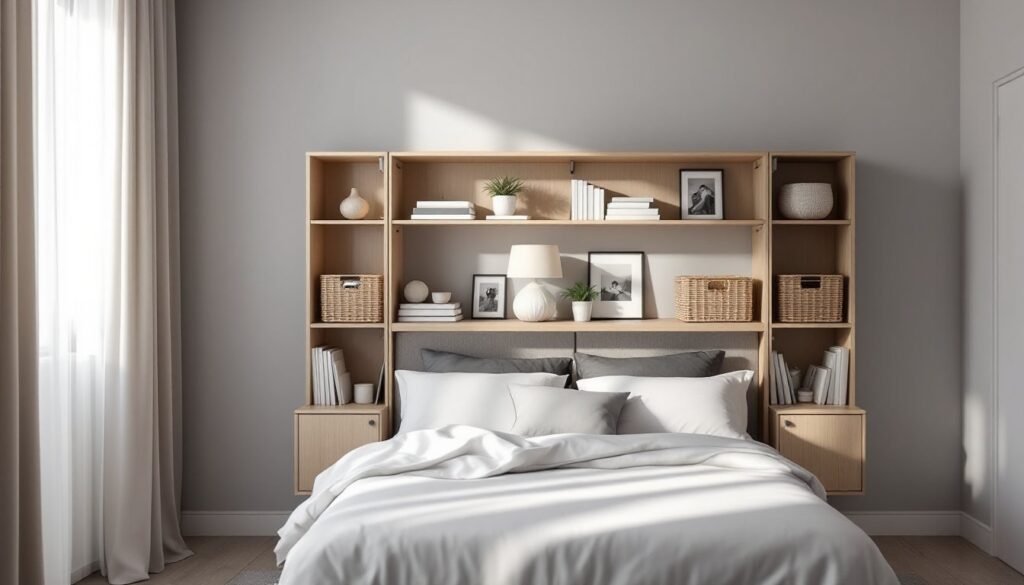
Open shelves are the design darling of 2026. They’re approachable, they let you show off decorative items or favorite books, and they’re usually the cheapest option to build or buy. Open shelves work best when you’re intentional about what goes on them, think coordinated storage baskets, a curated book collection, or bedside essentials grouped neatly.
The downside? Dust settles on everything, and you can’t hide the mess. If your nightstand is currently a graveyard of hair ties, tissues, and old receipts, open shelving will expose that daily. You’ll need to stay organized or the headboard becomes a visual janky mess. Also, shelves have weight limits, typically 25 to 40 pounds per shelf depending on the material and bracket system, so you can’t load them with a textbook collection or a rock collection.
Open designs are ideal if you sleep in a relatively dust-free environment or don’t mind wiping things down weekly. They’re also perfect if you’re renting and want something that won’t trigger lease disputes.
Closed Cabinet and Drawer Options
Closed headboards, those with cabinet doors, sliding panels, or deep drawers, hide clutter and keep dust off your stuff. They work brilliantly for storing bedding, pillows that aren’t in use, off-season clothes, or anything else you don’t need daily. A wooden cabinet with flush-mount hinges looks sleek and professional, while sliding barn-style doors add rustic charm.
The trade-off is visibility and cost. You can’t grab what you want at a glance without opening a door. Closed storage also eats up the bedroom visually if the headboard is deep or bulky. You need to plan what goes inside and keep a mental map, or you’ll spend five minutes pawing through drawers looking for that one fitted sheet.
How To Select The Right Size and Style
Start with your bed size and room dimensions. A queen-size bed (60″ wide) or king-size bed (76″ wide) needs a headboard that spans at least that width for visual balance. If you’re mounting a headboard directly to the wall studs, measure twice: you’ll want at least two 2×4 studs centered behind the bed to carry the weight. A typical headboard weighs anywhere from 50 to 150 pounds depending on material and storage depth, so proper mounting is non-negotiable, don’t hang it on drywall anchors alone.
Depth matters too. A headboard that juts out 8 to 12 inches from the wall is useful without making the room feel cramped. Anything deeper and it eats into walkway space or makes the bed feel like a fortress. If your room is under 150 square feet, stick with shallower designs, 6 to 8 inches maximum.
Style should complement your room’s vibe, not fight it. A minimalist room with clean lines calls for a headboard with simple shelving and no fussy trim. A farmhouse or cottage aesthetic might lean into solid wood with visible joinery or open shelves with simple baskets. Industrial spaces look sharp with metal frames and dark wood or plywood shelves.
Material choices are legion: plywood, solid pine or oak, MDF, or even reclaimed wood. Budget matters here too. Solid wood costs more but ages beautifully and can handle weight better. Plywood is cheaper, strong enough for shelving, and takes stain or paint well. MDF is budget-friendly but less durable around moisture, avoid it if your bedroom is humid.
Practical Tips for Organizing Headboard Storage
An unorganized storage headboard is just a shelf that collects junk. Here’s how to keep it functional long-term.
Group by category and frequency of use. Items you grab nightly, phone charger, lamp, current read, glasses, go in the most accessible spots, typically 12 to 18 inches from the mattress surface. Seasonal items, extra pillows, or off-season bedding go higher up or in closed compartments below or behind.
Use consistent containers. If you’re using open shelves, baskets or bins in matching sizes create visual calm and define what belongs where. A 12-inch-wide woven basket might hold folded blankets: a 6-inch cube organizer holds socks and undergarments. Consistency makes scanning for what you need faster, and it looks intentional rather than chaotic.
Keep weight distributed. Don’t load one shelf with all the heavy stuff. A stack of books can weigh 20 to 30 pounds per cubic foot, so spread them across shelves and pair them with lighter items like plants, framed photos, or fabric.
Label drawers or bins. Even if your headboard is in your bedroom and only you see it, labeling saves the frustration of opening four drawers looking for the pillowcase set. A label maker and simple adhesive labels take three minutes and save twenty minutes of future searching.
Limit decorative items to 30% of the space. Your headboard’s primary job is storage, not display. One or two framed photos, a small plant, or a candle on a shelf is nice visual balance. Fill the rest with functional items in organized containers using furniture-building guidance from experienced DIYers.
Conclusion
A bed with a storage headboard is a smart investment for any bedroom, especially when square footage is limited. The key is choosing a design that fits your space, mounting it safely, and committing to keeping it organized. Whether you go open shelves or closed cabinets, the real payoff is reclaiming your bedroom from clutter and creating a space that actually works for how you live.